UX Research
NATIVE ONBOARDING PROCESS
NATIVE ONBOARDING PROCESS
Year :
2023
Industry :
Trade & Crypto
Client :
Tradestation
Project Duration :
2 weeks

Enter password to view case study
🛑 THE PROBLEM:
TradeStation faced a critical growth challenge. While competitors like Robinhood, E*Trade, and TD Ameritrade were rapidly expanding by offering fast, intuitive, beginner-friendly onboarding experiences, TradeStation’s onboarding flow remained complex, technical, and tailored mainly to advanced traders.
New users—especially those with little or no trading experience—struggled to complete the account-creation process due to long forms, unclear steps, heavy terminology, and a lack of guidance.
As a result, TradeStation was losing potential clients at the very first stage of engagement. To stay competitive, it was essential to evaluate the current onboarding journey, identify usability barriers, and uncover opportunities for a simplified, modern, and accessible experience that could attract a broader audience.
🎯 GOALS:
Expand TradeStation’s user base by making the onboarding process accessible not only to advanced traders but also to beginners and casual investors.
Identify usability issues and friction points in the current onboarding flow that contribute to drop-offs and user frustration.
Benchmark the experience against leading competitors to understand expectations, industry standards, and the gaps holding TradeStation back.
Simplify the onboarding process through clearer guidance, improved microcopy, and reduced cognitive load.
Improve learnability so new users—regardless of experience level—can complete onboarding without confusion.
Enhance clarity and transparency around identity verification, requirements, and next steps to strengthen user trust.
Increase overall conversion rates by streamlining steps, reducing errors, and removing unnecessary complexity.
Modernize the onboarding experience to align with the intuitive, friendly flows that users expect from top-performing trading apps.
🧐 UX AUDIT:
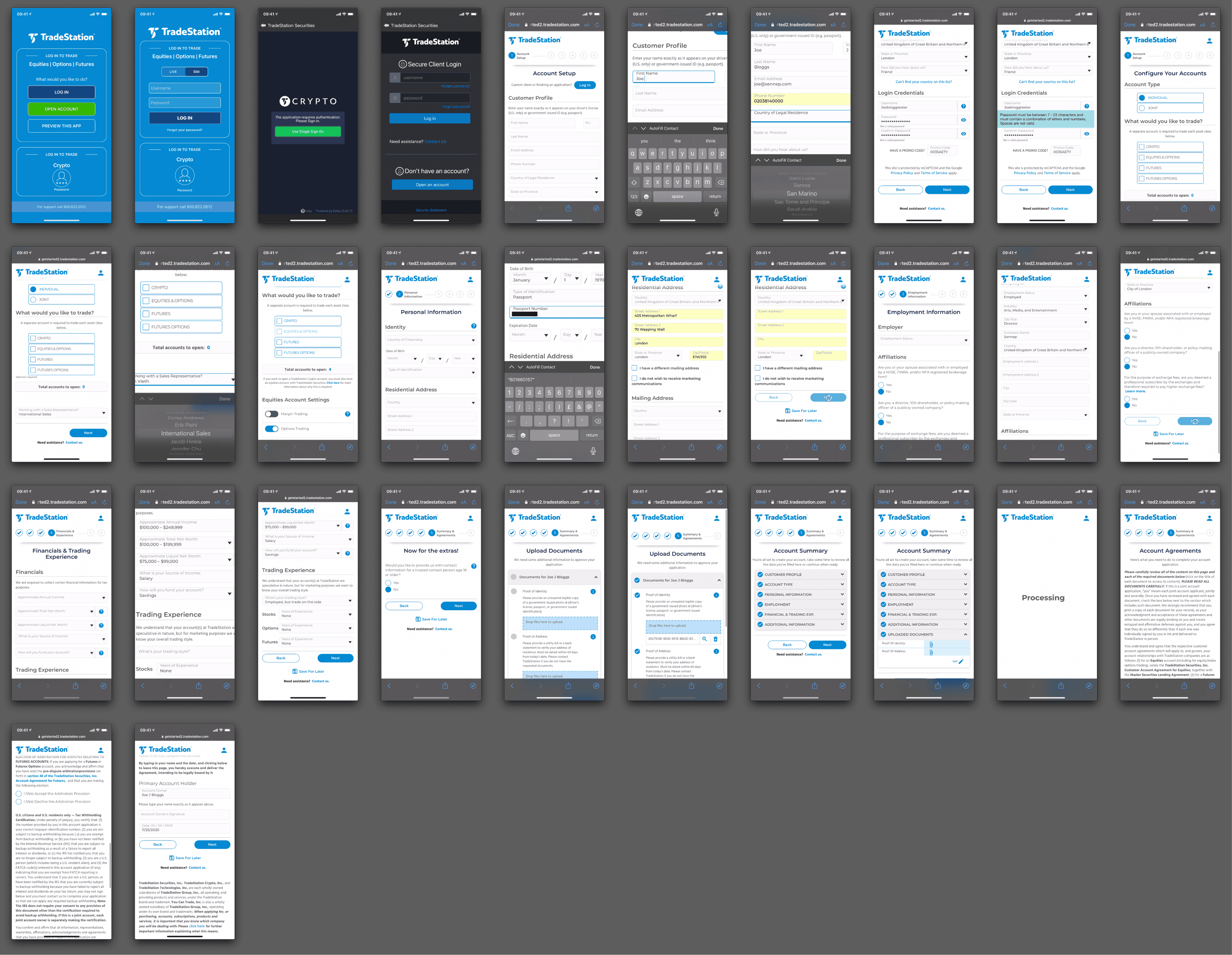
A complete UX Audit was conducted to analyze every step of the TradeStation onboarding experience—from account creation to identity verification and initial setup. The audit focused on uncovering usability issues, friction points, and gaps that were preventing users from completing the process smoothly, especially compared to modern competitor standards.
Working directly in Figma, I documented the full onboarding flow and annotated each interaction with:
✔ Pain Points
Clear identification of the moments where users struggled, hesitated, or encountered unnecessary complexity.
✔ Key Takeaways
High-level insights explaining why certain issues were occurring and how they impacted user behavior, trust, and conversion.
✔ UX Recommendations
Actionable solutions for simplifying steps, clarifying requirements, improving microcopy, reducing cognitive load, and aligning the flow with industry best practices.
✔ Step-by-Step Annotations
Detailed notes placed directly on each screen to visualize how the onboarding experience could be improved, including layout details, interaction patterns, terminology, and visual hierarchy.
The audit also highlighted inconsistencies in UI behavior, outdated patterns, and areas where advanced terminology created confusion for new investors. These insights provided a concrete roadmap for modernizing the onboarding process, reducing user friction, and helping TradeStation become more competitive in a market driven by simplicity and accessibility.
To communicate the findings clearly, the entire audit was presented through a video walkthrough, showcasing the annotated flow, explaining each pain point, and demonstrating the potential impact of the proposed solutions.
🎥 Video Walkthrough of the Presentation to Stakeholders
📊 COMPETITORS ANALYSIS
As part of the audit, a competitive review was conducted across several leading investing and trading platforms—including Donut, Tickr, Stake, Plum, FreeTrade, Coinbase, and Robinhood. The goal was to analyze their onboarding flows, identify modern patterns, and understand how top-performing apps simplify account creation for users of all experience levels. This comparison revealed best practices in guidance, microcopy, identity verification, and overall flow efficiency, highlighting clear opportunities for TradeStation to modernize its onboarding experience and remain competitive in a rapidly evolving market.


⚠️ CHALLENGES:
TradeStation’s onboarding flow presented several challenges rooted in its legacy design, technical complexity, and focus on experienced traders. One of the biggest obstacles was simplifying a process originally built for knowledgeable investors without compromising regulatory requirements or data accuracy. Many parts of the flow were overloaded with dense terminology, complex forms, and multi-step verification screens that overwhelmed new users.
Another major challenge was aligning the experience with modern standards set by popular trading apps. Competing platforms offered faster, more intuitive onboarding, which raised user expectations and made TradeStation’s flow feel outdated and intimidating. Balancing business needs, regulatory constraints, and user-friendly design required careful evaluation and thoughtful recommendations based on real-world behavior and industry benchmarks.
✨ SUMMARY:
The UX audit revealed that TradeStation’s onboarding experience was unintentionally excluding beginner and intermediate investors due to unnecessary complexity, unclear guidance, and outdated UX patterns. By breaking down the full flow, identifying pain points, and mapping opportunities for improvement, the audit provided a clear roadmap for modernizing the experience.
The analysis emphasized the need for simplified steps, improved language, stronger guidance, and a more intuitive structure that aligns with user expectations shaped by leading competitors. These insights created a foundation for a more inclusive onboarding flow capable of supporting TradeStation’s growth goals.

🚀 Impact
The audit delivered a comprehensive understanding of where users were struggling and how the onboarding experience could be transformed into a more welcoming, accessible, and conversion-driven flow. The documented recommendations equipped product and design teams with actionable steps for improving usability, reducing drop-offs, and increasing user confidence.
By addressing these issues, TradeStation gained a clear path to:
Attract a broader range of investors
Align with modern UX standards
Strengthen user trust during the account-creation process
Improve completion rates and accelerate user activation
The UX audit ultimately positioned TradeStation to compete more effectively in a market where simplicity, clarity, and speed define the best onboarding experiences.
👤 My Role
UX Researcher & Product Designer
📦 Key Deliverables
Competitors Analysis
UX Audit
Usage Guidelines & Documentation
Presentation of the Design System to Stakeholders
More Projects


UX Research
NATIVE ONBOARDING PROCESS
NATIVE ONBOARDING PROCESS
Year :
2023
Industry :
Trade & Crypto
Client :
Tradestation
Project Duration :
2 weeks
Enter password to view case study
🛑 THE PROBLEM:
TradeStation faced a critical growth challenge. While competitors like Robinhood, E*Trade, and TD Ameritrade were rapidly expanding by offering fast, intuitive, beginner-friendly onboarding experiences, TradeStation’s onboarding flow remained complex, technical, and tailored mainly to advanced traders.
New users—especially those with little or no trading experience—struggled to complete the account-creation process due to long forms, unclear steps, heavy terminology, and a lack of guidance.
As a result, TradeStation was losing potential clients at the very first stage of engagement. To stay competitive, it was essential to evaluate the current onboarding journey, identify usability barriers, and uncover opportunities for a simplified, modern, and accessible experience that could attract a broader audience.
🎯 GOALS:
Expand TradeStation’s user base by making the onboarding process accessible not only to advanced traders but also to beginners and casual investors.
Identify usability issues and friction points in the current onboarding flow that contribute to drop-offs and user frustration.
Benchmark the experience against leading competitors to understand expectations, industry standards, and the gaps holding TradeStation back.
Simplify the onboarding process through clearer guidance, improved microcopy, and reduced cognitive load.
Improve learnability so new users—regardless of experience level—can complete onboarding without confusion.
Enhance clarity and transparency around identity verification, requirements, and next steps to strengthen user trust.
Increase overall conversion rates by streamlining steps, reducing errors, and removing unnecessary complexity.
Modernize the onboarding experience to align with the intuitive, friendly flows that users expect from top-performing trading apps.
🧐 UX AUDIT:
A complete UX Audit was conducted to analyze every step of the TradeStation onboarding experience—from account creation to identity verification and initial setup. The audit focused on uncovering usability issues, friction points, and gaps that were preventing users from completing the process smoothly, especially compared to modern competitor standards.
Working directly in Figma, I documented the full onboarding flow and annotated each interaction with:
✔ Pain Points
Clear identification of the moments where users struggled, hesitated, or encountered unnecessary complexity.
✔ Key Takeaways
High-level insights explaining why certain issues were occurring and how they impacted user behavior, trust, and conversion.
✔ UX Recommendations
Actionable solutions for simplifying steps, clarifying requirements, improving microcopy, reducing cognitive load, and aligning the flow with industry best practices.
✔ Step-by-Step Annotations
Detailed notes placed directly on each screen to visualize how the onboarding experience could be improved, including layout details, interaction patterns, terminology, and visual hierarchy.
The audit also highlighted inconsistencies in UI behavior, outdated patterns, and areas where advanced terminology created confusion for new investors. These insights provided a concrete roadmap for modernizing the onboarding process, reducing user friction, and helping TradeStation become more competitive in a market driven by simplicity and accessibility.
To communicate the findings clearly, the entire audit was presented through a video walkthrough, showcasing the annotated flow, explaining each pain point, and demonstrating the potential impact of the proposed solutions.
🎥 Video Walkthrough of the Presentation to Stakeholders
📊 COMPETITORS ANALYSIS
As part of the audit, a competitive review was conducted across several leading investing and trading platforms—including Donut, Tickr, Stake, Plum, FreeTrade, Coinbase, and Robinhood. The goal was to analyze their onboarding flows, identify modern patterns, and understand how top-performing apps simplify account creation for users of all experience levels. This comparison revealed best practices in guidance, microcopy, identity verification, and overall flow efficiency, highlighting clear opportunities for TradeStation to modernize its onboarding experience and remain competitive in a rapidly evolving market.
⚠️ CHALLENGES:
TradeStation’s onboarding flow presented several challenges rooted in its legacy design, technical complexity, and focus on experienced traders. One of the biggest obstacles was simplifying a process originally built for knowledgeable investors without compromising regulatory requirements or data accuracy. Many parts of the flow were overloaded with dense terminology, complex forms, and multi-step verification screens that overwhelmed new users.
Another major challenge was aligning the experience with modern standards set by popular trading apps. Competing platforms offered faster, more intuitive onboarding, which raised user expectations and made TradeStation’s flow feel outdated and intimidating. Balancing business needs, regulatory constraints, and user-friendly design required careful evaluation and thoughtful recommendations based on real-world behavior and industry benchmarks.
✨ SUMMARY:
The UX audit revealed that TradeStation’s onboarding experience was unintentionally excluding beginner and intermediate investors due to unnecessary complexity, unclear guidance, and outdated UX patterns. By breaking down the full flow, identifying pain points, and mapping opportunities for improvement, the audit provided a clear roadmap for modernizing the experience.
The analysis emphasized the need for simplified steps, improved language, stronger guidance, and a more intuitive structure that aligns with user expectations shaped by leading competitors. These insights created a foundation for a more inclusive onboarding flow capable of supporting TradeStation’s growth goals.
🚀 Impact
The audit delivered a comprehensive understanding of where users were struggling and how the onboarding experience could be transformed into a more welcoming, accessible, and conversion-driven flow. The documented recommendations equipped product and design teams with actionable steps for improving usability, reducing drop-offs, and increasing user confidence.
By addressing these issues, TradeStation gained a clear path to:
Attract a broader range of investors
Align with modern UX standards
Strengthen user trust during the account-creation process
Improve completion rates and accelerate user activation
The UX audit ultimately positioned TradeStation to compete more effectively in a market where simplicity, clarity, and speed define the best onboarding experiences.
👤 My Role
UX Researcher & Product Designer
📦 Key Deliverables
Competitors Analysis
UX Audit
Usage Guidelines & Documentation
Presentation of the Design System to Stakeholders
More Projects
UX Research
NATIVE ONBOARDING PROCESS
NATIVE ONBOARDING PROCESS
Year :
2023
Industry :
Trade & Crypto
Client :
Tradestation
Project Duration :
2 weeks
Enter password to view case study
🛑 THE PROBLEM:
TradeStation faced a critical growth challenge. While competitors like Robinhood, E*Trade, and TD Ameritrade were rapidly expanding by offering fast, intuitive, beginner-friendly onboarding experiences, TradeStation’s onboarding flow remained complex, technical, and tailored mainly to advanced traders.
New users—especially those with little or no trading experience—struggled to complete the account-creation process due to long forms, unclear steps, heavy terminology, and a lack of guidance.
As a result, TradeStation was losing potential clients at the very first stage of engagement. To stay competitive, it was essential to evaluate the current onboarding journey, identify usability barriers, and uncover opportunities for a simplified, modern, and accessible experience that could attract a broader audience.
🎯 GOALS:
Expand TradeStation’s user base by making the onboarding process accessible not only to advanced traders but also to beginners and casual investors.
Identify usability issues and friction points in the current onboarding flow that contribute to drop-offs and user frustration.
Benchmark the experience against leading competitors to understand expectations, industry standards, and the gaps holding TradeStation back.
Simplify the onboarding process through clearer guidance, improved microcopy, and reduced cognitive load.
Improve learnability so new users—regardless of experience level—can complete onboarding without confusion.
Enhance clarity and transparency around identity verification, requirements, and next steps to strengthen user trust.
Increase overall conversion rates by streamlining steps, reducing errors, and removing unnecessary complexity.
Modernize the onboarding experience to align with the intuitive, friendly flows that users expect from top-performing trading apps.
🧐 UX AUDIT:
A complete UX Audit was conducted to analyze every step of the TradeStation onboarding experience—from account creation to identity verification and initial setup. The audit focused on uncovering usability issues, friction points, and gaps that were preventing users from completing the process smoothly, especially compared to modern competitor standards.
Working directly in Figma, I documented the full onboarding flow and annotated each interaction with:
✔ Pain Points
Clear identification of the moments where users struggled, hesitated, or encountered unnecessary complexity.
✔ Key Takeaways
High-level insights explaining why certain issues were occurring and how they impacted user behavior, trust, and conversion.
✔ UX Recommendations
Actionable solutions for simplifying steps, clarifying requirements, improving microcopy, reducing cognitive load, and aligning the flow with industry best practices.
✔ Step-by-Step Annotations
Detailed notes placed directly on each screen to visualize how the onboarding experience could be improved, including layout details, interaction patterns, terminology, and visual hierarchy.
The audit also highlighted inconsistencies in UI behavior, outdated patterns, and areas where advanced terminology created confusion for new investors. These insights provided a concrete roadmap for modernizing the onboarding process, reducing user friction, and helping TradeStation become more competitive in a market driven by simplicity and accessibility.
To communicate the findings clearly, the entire audit was presented through a video walkthrough, showcasing the annotated flow, explaining each pain point, and demonstrating the potential impact of the proposed solutions.
🎥 Video Walkthrough of the Presentation to Stakeholders
📊 COMPETITORS ANALYSIS
As part of the audit, a competitive review was conducted across several leading investing and trading platforms—including Donut, Tickr, Stake, Plum, FreeTrade, Coinbase, and Robinhood. The goal was to analyze their onboarding flows, identify modern patterns, and understand how top-performing apps simplify account creation for users of all experience levels. This comparison revealed best practices in guidance, microcopy, identity verification, and overall flow efficiency, highlighting clear opportunities for TradeStation to modernize its onboarding experience and remain competitive in a rapidly evolving market.
⚠️ CHALLENGES:
TradeStation’s onboarding flow presented several challenges rooted in its legacy design, technical complexity, and focus on experienced traders. One of the biggest obstacles was simplifying a process originally built for knowledgeable investors without compromising regulatory requirements or data accuracy. Many parts of the flow were overloaded with dense terminology, complex forms, and multi-step verification screens that overwhelmed new users.
Another major challenge was aligning the experience with modern standards set by popular trading apps. Competing platforms offered faster, more intuitive onboarding, which raised user expectations and made TradeStation’s flow feel outdated and intimidating. Balancing business needs, regulatory constraints, and user-friendly design required careful evaluation and thoughtful recommendations based on real-world behavior and industry benchmarks.
✨ SUMMARY:
The UX audit revealed that TradeStation’s onboarding experience was unintentionally excluding beginner and intermediate investors due to unnecessary complexity, unclear guidance, and outdated UX patterns. By breaking down the full flow, identifying pain points, and mapping opportunities for improvement, the audit provided a clear roadmap for modernizing the experience.
The analysis emphasized the need for simplified steps, improved language, stronger guidance, and a more intuitive structure that aligns with user expectations shaped by leading competitors. These insights created a foundation for a more inclusive onboarding flow capable of supporting TradeStation’s growth goals.
🚀 Impact
The audit delivered a comprehensive understanding of where users were struggling and how the onboarding experience could be transformed into a more welcoming, accessible, and conversion-driven flow. The documented recommendations equipped product and design teams with actionable steps for improving usability, reducing drop-offs, and increasing user confidence.
By addressing these issues, TradeStation gained a clear path to:
Attract a broader range of investors
Align with modern UX standards
Strengthen user trust during the account-creation process
Improve completion rates and accelerate user activation
The UX audit ultimately positioned TradeStation to compete more effectively in a market where simplicity, clarity, and speed define the best onboarding experiences.
👤 My Role
UX Researcher & Product Designer
📦 Key Deliverables
Competitors Analysis
UX Audit
Usage Guidelines & Documentation
Presentation of the Design System to Stakeholders