Product Design
NAPA CRM System
NAPA CRM System
Year :
2022
Industry :
E-commerce
Client :
NAPA Autoparts
Project Duration :
24 weeks

Enter password to view case study
🛑 PROBLEM :
NAPA Auto Parts lacked a centralized and efficient system to track orders, monitor sales performance, and manage account assignments across its sales organization. Existing tools and third-party platforms were either too limited, too rigid, or too costly to customize for NAPA’s specific workflows. Sales teams struggled with inconsistent data, limited visibility into customer activity, and manual processes that slowed down decision-making and reduced productivity. Without a tailored CRM, the company faced operational inefficiencies, missed opportunities for growth, and an inability to scale its sales operations effectively.
🎯 Objectives / Goals
Create a centralized CRM system that consolidates order tracking, account management, and sales performance in one place.
Improve visibility and reporting for sales managers and executives, enabling data-driven decisions.
Streamline the sales workflow by reducing manual processes and eliminating fragmented tools.
Enable smart account assignment based on geographic coverage, customer type, and sales activity.
Increase sales efficiency and productivity by equipping the team with a system tailored to their real needs.
Reduce dependency on third-party platforms and avoid the high cost and limitations of existing CRM solutions.
Design a scalable foundation that supports future growth, additional features, and evolving business requirements.
🔎 Research & Foundations
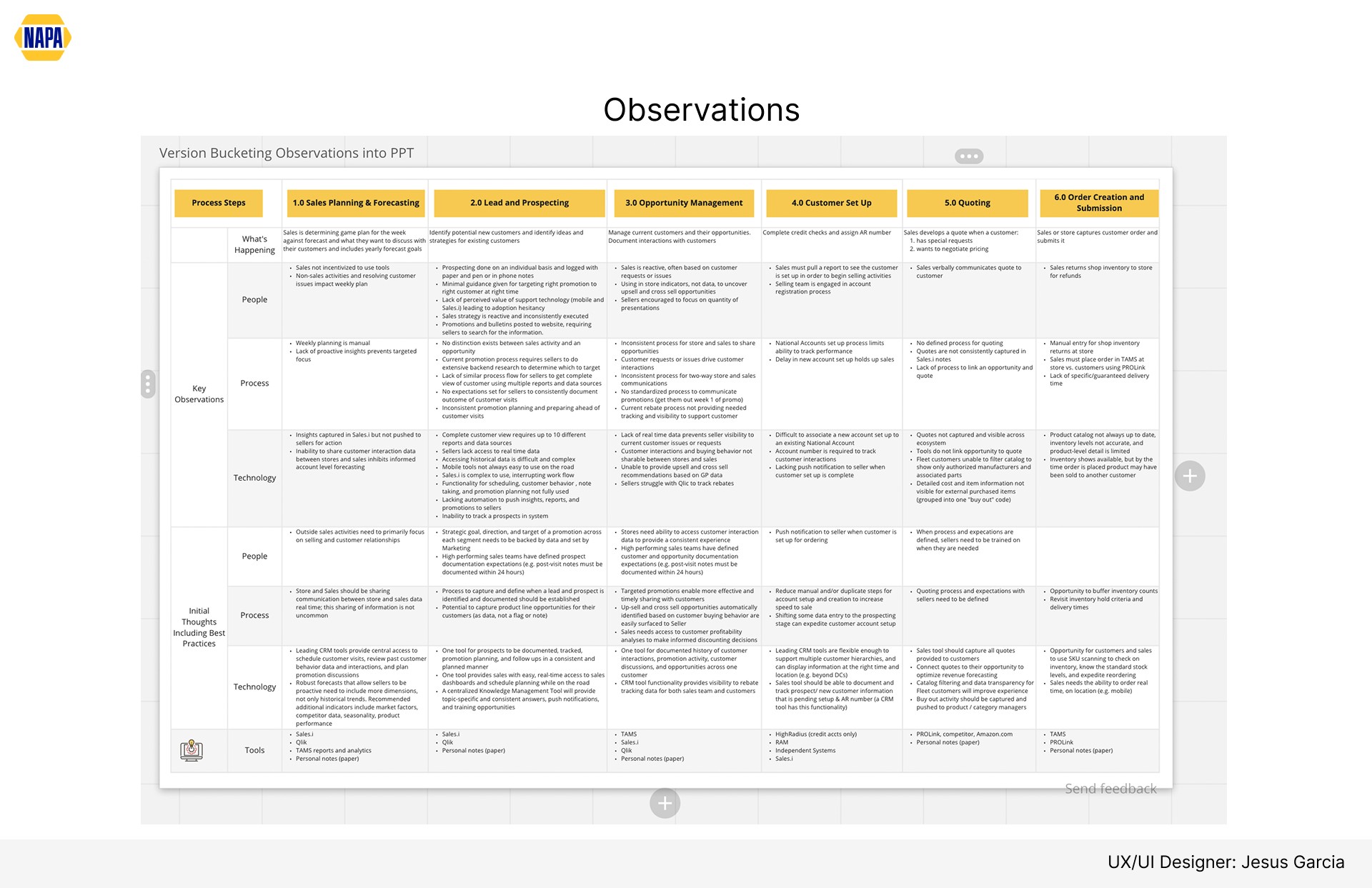
Before designing the new NAPA CSA CRM, I immersed myself in understanding how the current program truly worked. I reviewed program guides, training materials, workflows, and roles to uncover how store owners, sales associates, and distribution centers collaborated — and where things were breaking down.
As I pieced together the daily routines of CSAs, a clear picture emerged: everyone was striving toward growth, but processes were inconsistent, communication was fragmented, and reporting lacked structure. Stores struggled to maintain momentum, sales teams lacked unified tools, and performance tracking often depended on manual effort.
This research revealed a fundamental need: a centralized CRM that could bring clarity, standardize workflows, support sales performance, and finally align all parts of the CSA ecosystem.
With this foundation, the path forward became clear — design a system that reflects the real challenges, goals, and rhythms of the people who rely on it every day.


🔎 Research artifacts




📊 Competitors Analysis
To identify the best direction for NAPA’s new CRM, I conducted a comparative analysis of two leading platforms — Salesforce and Sales-i — evaluating their capabilities, scalability, and long-term fit for NAPA’s Commercial Sales Associate program.
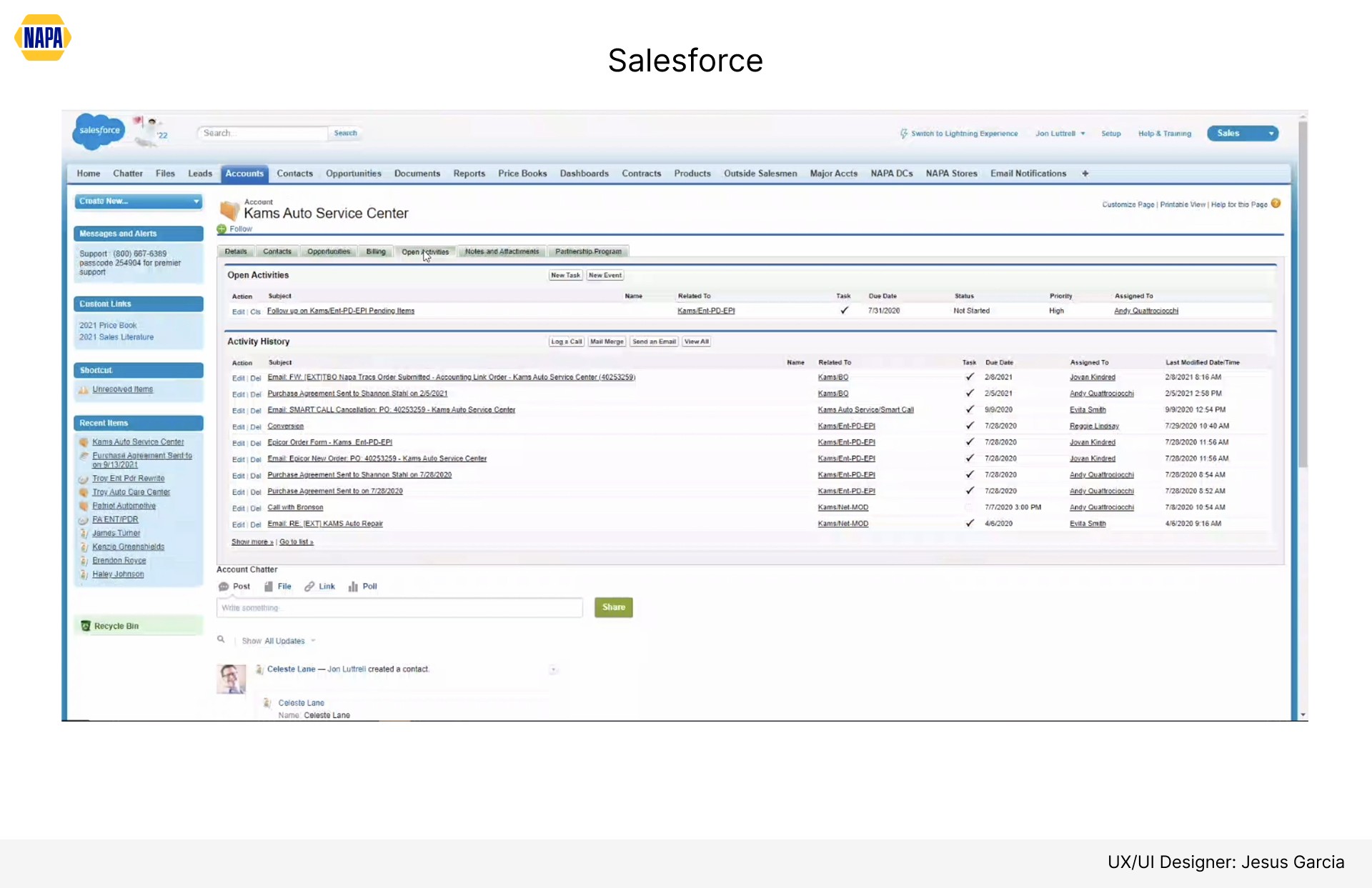
Salesforce
Salesforce offered strong customization, robust reporting, and enterprise-level integrations. However, its high licensing costs, complex setup, and ongoing maintenance requirements made it difficult to justify at scale.




Sales i
Sales-i provided useful sales intelligence tools and simpler onboarding, but it lacked the specific workflows, role-based controls, and customization flexibility required to support NAPA’s unique CSA structure and sales processes.


Conclusion:
Although both platforms delivered valuable features, neither fully aligned with NAPA’s operational needs or budget constraints. As a result, we determined that building a fully custom CRM would provide the best balance of flexibility, scalability, cost-efficiency, and long-term control — ensuring the system could evolve alongside NAPA’s growth strategy.
Inspiration
Before defining the visual direction of the CRM, I created a moodboard to explore the tone, clarity, and structure the system needed to communicate. Through this process, I gathered visual references that reflected NAPA’s identity while introducing a more modern and intuitive aesthetic. Clean layouts, strong hierarchy, bold but functional color accents, and simplified components became key themes. The moodboard served as an early creative compass, helping stakeholders visualize the future experience and ensuring that every design decision — from typography to iconography — felt aligned, purposeful, and intentional.


wireframes
With a clear understanding of the users and their workflows, I began shaping the solution through a series of wireframes that explored how the CRM would look and behave across desktop, tablet, and mobile. These early sketches became the first tangible expression of the system — a space where I experimented with layouts, reorganized information, and tested different ways to simplify complex sales processes. Seeing the three versions side by side helped uncover opportunities for consistency, responsive patterns, and task-focused interactions. Each iteration brought the design closer to a system that felt natural, intuitive, and truly aligned with the daily routines of NAPA’s sales teams.
🚀 THE SOLUTION (HI-FI)
🚀 Impact
The moment the CRM vision came together, the organization finally saw its sales ecosystem as a unified whole. Store owners, CSAs, and managers — who had long worked in disconnected ways — could now imagine a shared, streamlined workflow built around their actual needs.
The research exposed hidden inefficiencies, the workflows clarified where communication broke down, and the early designs gave everyone a clear picture of how much smoother and more connected their work could be.
By choosing a custom-built CRM, NAPA gained more than a tool — they gained alignment, clarity, and a foundation built specifically for their people and their processes. The project didn’t just improve operations; it set the stage for a more efficient and collaborative future.
⚠️ CHALLENGES :
When I began working on the CRM, it quickly became clear that NAPA’s sales ecosystem wasn’t just complex — it was fragmented in ways that made growth difficult. Each store had its own routines, CSAs worked with tools that varied wildly in structure and reliability, and critical sales information lived in spreadsheets, emails, or people’s memory. Nothing operated from a single source of truth.
On top of that, the existing CRMs we evaluated either couldn’t adapt to NAPA’s unique workflows or came with heavy costs and long-term dependencies. The challenge wasn’t simply to design a tool — it was to bring order, clarity, and alignment to a system where everyone was working hard, but not always together. The CRM needed to support their real daily rhythms, not force them into a rigid template.
📄 SUMMARY:
This project became an opportunity to reimagine how the entire NAPA sales ecosystem could function. Through research, interviews, workflow mapping, and competitive analysis, I uncovered the moments where communication broke down, where data got lost, and where sales teams were forced to improvise because the right tools didn’t exist.
The solution was not another off-the-shelf system — it was a fully custom CRM shaped around the real stories, challenges, and daily pressures of the people who would use it. The final design brought structure to the chaos: clear workflows, organized account management, better visibility for managers, and a foundation that could evolve as NAPA grows. What started as a disconnected process became a unified ecosystem with purpose, direction, and room for innovation.
👤 My Role
Lead Product Designer
My role was to lead the project from discovery through conceptual design, acting as the bridge between the people doing the work and the system that needed to support them. I immersed myself in the CSA program, spoke with stakeholders across the organization, mapped their workflows, and analyzed how each role connected to the next.
From there, I transformed insights into design direction — creating moodboards, defining structural patterns, and exploring layouts across desktop, tablet, and mobile. I translated messy processes into clean, intuitive flows and shaped the first blueprint of what a unified NAPA CRM could be. My goal throughout the project was simple: design a system that feels like it was built for them, not forced on them.
📦 Key Deliverables
Throughout this project, I delivered a set of artifacts that helped NAPA visualize and align around the future CRM:
A narrative-rich research synthesis that revealed how the CSA program truly operates
A competitive analysis comparing Salesforce and Sales-i, highlighting why a custom solution was the right path
Workflow maps and ecosystem diagrams that showed exactly where processes broke down
Personas and journey insights that humanized the needs behind each role
A moodboard that helped define the visual tone of the system
Multi-platform wireframes that translated complex processes into simple, intuitive screens
A foundational blueprint outlining navigation, structure, and user flows


More Projects


Product Design
NAPA CRM System
NAPA CRM System
Year :
2022
Industry :
E-commerce
Client :
NAPA Autoparts
Project Duration :
24 weeks
Enter password to view case study
🛑 PROBLEM :
NAPA Auto Parts lacked a centralized and efficient system to track orders, monitor sales performance, and manage account assignments across its sales organization. Existing tools and third-party platforms were either too limited, too rigid, or too costly to customize for NAPA’s specific workflows. Sales teams struggled with inconsistent data, limited visibility into customer activity, and manual processes that slowed down decision-making and reduced productivity. Without a tailored CRM, the company faced operational inefficiencies, missed opportunities for growth, and an inability to scale its sales operations effectively.
🎯 Objectives / Goals
Create a centralized CRM system that consolidates order tracking, account management, and sales performance in one place.
Improve visibility and reporting for sales managers and executives, enabling data-driven decisions.
Streamline the sales workflow by reducing manual processes and eliminating fragmented tools.
Enable smart account assignment based on geographic coverage, customer type, and sales activity.
Increase sales efficiency and productivity by equipping the team with a system tailored to their real needs.
Reduce dependency on third-party platforms and avoid the high cost and limitations of existing CRM solutions.
Design a scalable foundation that supports future growth, additional features, and evolving business requirements.
🔎 Research & Foundations
Before designing the new NAPA CSA CRM, I immersed myself in understanding how the current program truly worked. I reviewed program guides, training materials, workflows, and roles to uncover how store owners, sales associates, and distribution centers collaborated — and where things were breaking down.
As I pieced together the daily routines of CSAs, a clear picture emerged: everyone was striving toward growth, but processes were inconsistent, communication was fragmented, and reporting lacked structure. Stores struggled to maintain momentum, sales teams lacked unified tools, and performance tracking often depended on manual effort.
This research revealed a fundamental need: a centralized CRM that could bring clarity, standardize workflows, support sales performance, and finally align all parts of the CSA ecosystem.
With this foundation, the path forward became clear — design a system that reflects the real challenges, goals, and rhythms of the people who rely on it every day.
🔎 Research artifacts
📊 Competitors Analysis
To identify the best direction for NAPA’s new CRM, I conducted a comparative analysis of two leading platforms — Salesforce and Sales-i — evaluating their capabilities, scalability, and long-term fit for NAPA’s Commercial Sales Associate program.
Salesforce
Salesforce offered strong customization, robust reporting, and enterprise-level integrations. However, its high licensing costs, complex setup, and ongoing maintenance requirements made it difficult to justify at scale.
Sales i
Sales-i provided useful sales intelligence tools and simpler onboarding, but it lacked the specific workflows, role-based controls, and customization flexibility required to support NAPA’s unique CSA structure and sales processes.
Conclusion:
Although both platforms delivered valuable features, neither fully aligned with NAPA’s operational needs or budget constraints. As a result, we determined that building a fully custom CRM would provide the best balance of flexibility, scalability, cost-efficiency, and long-term control — ensuring the system could evolve alongside NAPA’s growth strategy.
Inspiration
Before defining the visual direction of the CRM, I created a moodboard to explore the tone, clarity, and structure the system needed to communicate. Through this process, I gathered visual references that reflected NAPA’s identity while introducing a more modern and intuitive aesthetic. Clean layouts, strong hierarchy, bold but functional color accents, and simplified components became key themes. The moodboard served as an early creative compass, helping stakeholders visualize the future experience and ensuring that every design decision — from typography to iconography — felt aligned, purposeful, and intentional.
wireframes
With a clear understanding of the users and their workflows, I began shaping the solution through a series of wireframes that explored how the CRM would look and behave across desktop, tablet, and mobile. These early sketches became the first tangible expression of the system — a space where I experimented with layouts, reorganized information, and tested different ways to simplify complex sales processes. Seeing the three versions side by side helped uncover opportunities for consistency, responsive patterns, and task-focused interactions. Each iteration brought the design closer to a system that felt natural, intuitive, and truly aligned with the daily routines of NAPA’s sales teams.
🚀 THE SOLUTION (HI-FI)
🚀 Impact
The moment the CRM vision came together, the organization finally saw its sales ecosystem as a unified whole. Store owners, CSAs, and managers — who had long worked in disconnected ways — could now imagine a shared, streamlined workflow built around their actual needs.
The research exposed hidden inefficiencies, the workflows clarified where communication broke down, and the early designs gave everyone a clear picture of how much smoother and more connected their work could be.
By choosing a custom-built CRM, NAPA gained more than a tool — they gained alignment, clarity, and a foundation built specifically for their people and their processes. The project didn’t just improve operations; it set the stage for a more efficient and collaborative future.
⚠️ CHALLENGES :
When I began working on the CRM, it quickly became clear that NAPA’s sales ecosystem wasn’t just complex — it was fragmented in ways that made growth difficult. Each store had its own routines, CSAs worked with tools that varied wildly in structure and reliability, and critical sales information lived in spreadsheets, emails, or people’s memory. Nothing operated from a single source of truth.
On top of that, the existing CRMs we evaluated either couldn’t adapt to NAPA’s unique workflows or came with heavy costs and long-term dependencies. The challenge wasn’t simply to design a tool — it was to bring order, clarity, and alignment to a system where everyone was working hard, but not always together. The CRM needed to support their real daily rhythms, not force them into a rigid template.
📄 SUMMARY:
This project became an opportunity to reimagine how the entire NAPA sales ecosystem could function. Through research, interviews, workflow mapping, and competitive analysis, I uncovered the moments where communication broke down, where data got lost, and where sales teams were forced to improvise because the right tools didn’t exist.
The solution was not another off-the-shelf system — it was a fully custom CRM shaped around the real stories, challenges, and daily pressures of the people who would use it. The final design brought structure to the chaos: clear workflows, organized account management, better visibility for managers, and a foundation that could evolve as NAPA grows. What started as a disconnected process became a unified ecosystem with purpose, direction, and room for innovation.
👤 My Role
Lead Product Designer
My role was to lead the project from discovery through conceptual design, acting as the bridge between the people doing the work and the system that needed to support them. I immersed myself in the CSA program, spoke with stakeholders across the organization, mapped their workflows, and analyzed how each role connected to the next.
From there, I transformed insights into design direction — creating moodboards, defining structural patterns, and exploring layouts across desktop, tablet, and mobile. I translated messy processes into clean, intuitive flows and shaped the first blueprint of what a unified NAPA CRM could be. My goal throughout the project was simple: design a system that feels like it was built for them, not forced on them.
📦 Key Deliverables
Throughout this project, I delivered a set of artifacts that helped NAPA visualize and align around the future CRM:
A narrative-rich research synthesis that revealed how the CSA program truly operates
A competitive analysis comparing Salesforce and Sales-i, highlighting why a custom solution was the right path
Workflow maps and ecosystem diagrams that showed exactly where processes broke down
Personas and journey insights that humanized the needs behind each role
A moodboard that helped define the visual tone of the system
Multi-platform wireframes that translated complex processes into simple, intuitive screens
A foundational blueprint outlining navigation, structure, and user flows
More Projects
Product Design
NAPA CRM System
NAPA CRM System
Year :
2022
Industry :
E-commerce
Client :
NAPA Autoparts
Project Duration :
24 weeks
Enter password to view case study
🛑 PROBLEM :
NAPA Auto Parts lacked a centralized and efficient system to track orders, monitor sales performance, and manage account assignments across its sales organization. Existing tools and third-party platforms were either too limited, too rigid, or too costly to customize for NAPA’s specific workflows. Sales teams struggled with inconsistent data, limited visibility into customer activity, and manual processes that slowed down decision-making and reduced productivity. Without a tailored CRM, the company faced operational inefficiencies, missed opportunities for growth, and an inability to scale its sales operations effectively.
🎯 Objectives / Goals
Create a centralized CRM system that consolidates order tracking, account management, and sales performance in one place.
Improve visibility and reporting for sales managers and executives, enabling data-driven decisions.
Streamline the sales workflow by reducing manual processes and eliminating fragmented tools.
Enable smart account assignment based on geographic coverage, customer type, and sales activity.
Increase sales efficiency and productivity by equipping the team with a system tailored to their real needs.
Reduce dependency on third-party platforms and avoid the high cost and limitations of existing CRM solutions.
Design a scalable foundation that supports future growth, additional features, and evolving business requirements.
🔎 Research & Foundations
Before designing the new NAPA CSA CRM, I immersed myself in understanding how the current program truly worked. I reviewed program guides, training materials, workflows, and roles to uncover how store owners, sales associates, and distribution centers collaborated — and where things were breaking down.
As I pieced together the daily routines of CSAs, a clear picture emerged: everyone was striving toward growth, but processes were inconsistent, communication was fragmented, and reporting lacked structure. Stores struggled to maintain momentum, sales teams lacked unified tools, and performance tracking often depended on manual effort.
This research revealed a fundamental need: a centralized CRM that could bring clarity, standardize workflows, support sales performance, and finally align all parts of the CSA ecosystem.
With this foundation, the path forward became clear — design a system that reflects the real challenges, goals, and rhythms of the people who rely on it every day.
🔎 Research artifacts
📊 Competitors Analysis
To identify the best direction for NAPA’s new CRM, I conducted a comparative analysis of two leading platforms — Salesforce and Sales-i — evaluating their capabilities, scalability, and long-term fit for NAPA’s Commercial Sales Associate program.
Salesforce
Salesforce offered strong customization, robust reporting, and enterprise-level integrations. However, its high licensing costs, complex setup, and ongoing maintenance requirements made it difficult to justify at scale.
Sales i
Sales-i provided useful sales intelligence tools and simpler onboarding, but it lacked the specific workflows, role-based controls, and customization flexibility required to support NAPA’s unique CSA structure and sales processes.
Conclusion:
Although both platforms delivered valuable features, neither fully aligned with NAPA’s operational needs or budget constraints. As a result, we determined that building a fully custom CRM would provide the best balance of flexibility, scalability, cost-efficiency, and long-term control — ensuring the system could evolve alongside NAPA’s growth strategy.
Inspiration
Before defining the visual direction of the CRM, I created a moodboard to explore the tone, clarity, and structure the system needed to communicate. Through this process, I gathered visual references that reflected NAPA’s identity while introducing a more modern and intuitive aesthetic. Clean layouts, strong hierarchy, bold but functional color accents, and simplified components became key themes. The moodboard served as an early creative compass, helping stakeholders visualize the future experience and ensuring that every design decision — from typography to iconography — felt aligned, purposeful, and intentional.
wireframes
With a clear understanding of the users and their workflows, I began shaping the solution through a series of wireframes that explored how the CRM would look and behave across desktop, tablet, and mobile. These early sketches became the first tangible expression of the system — a space where I experimented with layouts, reorganized information, and tested different ways to simplify complex sales processes. Seeing the three versions side by side helped uncover opportunities for consistency, responsive patterns, and task-focused interactions. Each iteration brought the design closer to a system that felt natural, intuitive, and truly aligned with the daily routines of NAPA’s sales teams.
🚀 THE SOLUTION (HI-FI)
🚀 Impact
The moment the CRM vision came together, the organization finally saw its sales ecosystem as a unified whole. Store owners, CSAs, and managers — who had long worked in disconnected ways — could now imagine a shared, streamlined workflow built around their actual needs.
The research exposed hidden inefficiencies, the workflows clarified where communication broke down, and the early designs gave everyone a clear picture of how much smoother and more connected their work could be.
By choosing a custom-built CRM, NAPA gained more than a tool — they gained alignment, clarity, and a foundation built specifically for their people and their processes. The project didn’t just improve operations; it set the stage for a more efficient and collaborative future.
⚠️ CHALLENGES :
When I began working on the CRM, it quickly became clear that NAPA’s sales ecosystem wasn’t just complex — it was fragmented in ways that made growth difficult. Each store had its own routines, CSAs worked with tools that varied wildly in structure and reliability, and critical sales information lived in spreadsheets, emails, or people’s memory. Nothing operated from a single source of truth.
On top of that, the existing CRMs we evaluated either couldn’t adapt to NAPA’s unique workflows or came with heavy costs and long-term dependencies. The challenge wasn’t simply to design a tool — it was to bring order, clarity, and alignment to a system where everyone was working hard, but not always together. The CRM needed to support their real daily rhythms, not force them into a rigid template.
📄 SUMMARY:
This project became an opportunity to reimagine how the entire NAPA sales ecosystem could function. Through research, interviews, workflow mapping, and competitive analysis, I uncovered the moments where communication broke down, where data got lost, and where sales teams were forced to improvise because the right tools didn’t exist.
The solution was not another off-the-shelf system — it was a fully custom CRM shaped around the real stories, challenges, and daily pressures of the people who would use it. The final design brought structure to the chaos: clear workflows, organized account management, better visibility for managers, and a foundation that could evolve as NAPA grows. What started as a disconnected process became a unified ecosystem with purpose, direction, and room for innovation.
👤 My Role
Lead Product Designer
My role was to lead the project from discovery through conceptual design, acting as the bridge between the people doing the work and the system that needed to support them. I immersed myself in the CSA program, spoke with stakeholders across the organization, mapped their workflows, and analyzed how each role connected to the next.
From there, I transformed insights into design direction — creating moodboards, defining structural patterns, and exploring layouts across desktop, tablet, and mobile. I translated messy processes into clean, intuitive flows and shaped the first blueprint of what a unified NAPA CRM could be. My goal throughout the project was simple: design a system that feels like it was built for them, not forced on them.
📦 Key Deliverables
Throughout this project, I delivered a set of artifacts that helped NAPA visualize and align around the future CRM:
A narrative-rich research synthesis that revealed how the CSA program truly operates
A competitive analysis comparing Salesforce and Sales-i, highlighting why a custom solution was the right path
Workflow maps and ecosystem diagrams that showed exactly where processes broke down
Personas and journey insights that humanized the needs behind each role
A moodboard that helped define the visual tone of the system
Multi-platform wireframes that translated complex processes into simple, intuitive screens
A foundational blueprint outlining navigation, structure, and user flows